
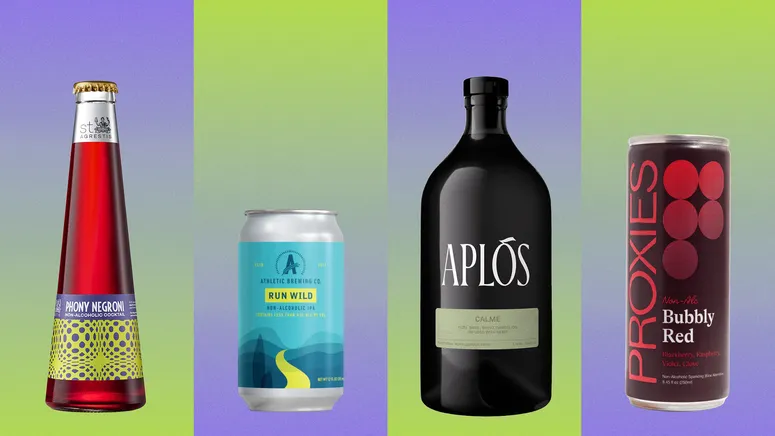
Every few months someone online kicks up the discourse around the cost of nonalcoholic cocktails, and it’s all we can do to escape it.
There’s a prevailing belief that nonalcoholic cocktails should cost less than alcoholic ones. It’s not hard to figure out why: Over 100 years ago, it was prohibited to produce, sell, and transport spirits. At the time it made sense to put a premium on a forbidden commodity that, sip by sip, made imbibers feel a little more relaxed, a little tipsy.
But that notion is not only outdated, but uninformed. At craft cocktail bars around the country, there is just as much cost, overhead, and sometimes even more labor involved with creating alcohol-free beverages.
It’s easy to overlook the creativity required to build nonalcoholic drinks in the intimacy of a craft cocktail bar. These cocktails are rarely “just” juice and a splash of soda water. “We wouldn’t serve the nonalcoholic drinks we make to a kid; they’re developed for a sophisticated palate,” says Harrison Ginsberg, the former bar director of Overstory and forthcoming bar lead of Crane Club in New York.
For traditional cocktails made with spirits, the structures and blueprints are time-tested. There are infinite permutations of alcohol, acid, and sugar for drinks like the Negroni or martini. Not so for their nonalcoholic counterparts, a nascent category that has only recently invited innovation as the number of such options flood the market. “You need to create texture and balance in a drink that doesn’t lean on an alcoholic component, because a lot of the flavor and viscosity of a drink comes from the alcohol itself,” says Leishla Maldonado, co-owner and beverage director of Loma in Providence.
Say you’re seeking out a nonalcoholic sour cocktail, “which is generally a little easier to achieve,” says Vay Su, co-owner of Vandell in Los Angeles, because acid is a reliable contributor to structure in drink. “But when you’re creating a ‘spirit-forward’ version, it’s super difficult to create something that tastes like alcohol.”
Good Zero-Proof Drinks Require More Ingredients, More Time
Not only is there more time and labor often involved with these very thoughtful beverages, but raw material costs add up. On a chemical level, alcohol is a very effective and relatively inexpensive extractor of flavor; water is simply unable to do the same job. Think the floral and woodsy qualities of gin or the vanilla-driven and smoky notes of whiskey–these flavor compounds are better dissolved in alcohol. Without a strong flavor carrier like this, it becomes challenging to build a nonalcoholic cocktail from scratch.
“When you’re extracting flavor with water, and you don’t have alcohol, you have to use double or triple the amount of raw ingredients to get that flavor across,” beverage consultant Christopher Longoria says. “That’s expensive on its own.”
“We have an NA milk punch that takes a long time,” Vandell’s Su says. “We sous vide the spices, clarify it, and top it off with pandan foam. That takes us two days, which is way more labor and cost than, say, making a Negroni.”
Overstory’s hojicha tonic is another example of a cocktail using high-quality, expensive ingredients. After being cold-steeped, the tea is made into a cordial, a two-day process. “That roasted green tea comes from a single farm in Japan, processed there and then brought to Brooklyn to a specialty tea supplier,” Ginsberg says. The other ingredients, a nonalcoholic vermouth and a nonalcoholic spirit alternative, cost just as much as their spirited counterparts. In this case, the margins are even thinner and profits slimmer than Overstory’s alcoholic choices.

Going sober curious doesn’t have to be a sacrifice.
Nonalcoholic Spirits Are Not Inexpensive
Averaged out, many NA spirits essentially cost the same as alcoholic spirits. To the consumer, a 700-ml bottle of Seedlip nonalcoholic spirit costs north of $30, as does a 500-ml bottle of Optimist Botanicals. A 700-ml bottle of The Pathfinder Spirit is $40. These zero-proof spirits are all about the same price of a bottle of mid-tier whiskey or gin.