


What we love: The Rorra was the countertop water filter that made me question whether I’ve been underestimating filtered water this whole time. Looks-wise, it’s beautiful, with a sleek, sculptural design that looks more like a piece of decor than a giant water cooler. For something that takes up this much real estate on your countertop, that matters.
What really impressed me, though, was how easy it was to install. If you’ve spent any time researching countertop water filters, you’ve probably encountered gravity-fed systems that require extensive filter priming and multiple rounds of flushing before they’re ready to use. The Rorra was refreshingly straightforward by comparison.
To set it up, I unpacked the system and laid out all of the components, which were clearly labeled with numbered steps that made the process easy to follow. First, I inserted the filter into its stainless steel housing and secured it to the bottom of the upper, unfiltered-water reservoir. Next, I removed the battery tab to activate the automatic filter-change indicator. From there, all that was left to do was place the reservoir on top of the base, fill it with cold water, and let it run through its first filtration cycle before use. That’s it. Compared to the other countertop systems I tested (which I expand on below), setting up the Rorra was shockingly simple.
Once it was running, it quickly became my favorite system to use day-to-day. The 2.8-gallon capacity meant I wasn’t constantly refilling it, and the convenient pour spout made grabbing a glass of water effortless. More importantly, the water tasted excellent—clean, crisp, and free of any weird flavor. It’s also one of the most comprehensive systems I tested, filtering PFAS, heavy metals, microplastics, chlorine, and other trace contaminants. If you’re someone who drinks a lot of water, fills reusable bottles throughout the day, or wants a highly effective filtration system without installing anything under your sink, the Rorra feels like a luxury upgrade that’s worth the coin.
What we’d leave: The obvious downside is the price. At nearly $450 before replacement filters, the Rorra costs significantly more than a pitcher or dispenser-style filter. It also takes up a substantial amount of counter space, so it’s probably not the best fit for tiny apartment kitchens. Additionally, replacement filters are expensive ($75 at the time of publishing) and only available through the brand, which makes long-term maintenance feel a little less convenient than grabbing a Brita filter during a Target run.
What to consider when shopping for a water filter
Water filters are one of those categories where marketing can get a little ahead of reality, which is why Kyle Postmus, senior manager of water systems at NSF, recommends paying close attention to independent certifications. “The most important question is not ‘Is this safe’ it’s ‘What was verified, by whom, and against which standard?’” he says. “Independent certification means the product was tested against established criteria and is subject to ongoing oversight, including periodic retesting and facility audits.”
Rather than relying on broad claims like “pure” or “clean,” look for certifications such as NSF/ANSI 42, 53, or 401, which indicate a product has been independently tested to reduce specific contaminants. When in doubt, verify products through NSF’s certified products listing rather than relying on front-of-package claims.
Even the best water filter is only as effective as its maintenance schedule. “Filters have finite treatment capacity, and delayed replacement can reduce effectiveness over time,” says Postmus. Some pitcher filters need replacing every couple of months, while larger countertop systems can last six months—or even a year—before requiring a new cartridge. Before buying, it’s worth considering not just the replacement schedule but also the cost and availability of replacement filters. A system may seem like a bargain upfront, but frequent or expensive filter changes can significantly increase the long-term cost of ownership.
The best water filter is the one you’ll actually use, which makes design and capacity surprisingly important considerations. According to Postmus, pitcher filters are often a good fit for renters, smaller households, and anyone prioritizing convenience, while countertop systems typically offer larger capacities and higher treatment volumes. Ultimately, the right size comes down to your household’s water consumption and how much space you’re willing to dedicate to filtration.
“Not all water filters remove the same contaminants, and that’s one of the biggest misconceptions consumers have,” says Postmus. Activated carbon filters are among the most common filters and are particularly effective at improving taste and odor by reducing chlorine and chloramine. Other systems may use ion exchange to reduce contaminants like lead, mechanical filtration to capture particles such as sediment and microplastics, or reverse osmosis to remove a broader range of dissolved contaminants. Many modern filters combine multiple technologies in a single system. “What matters most is not the marketing language around the technology,” says Postmus, “but whether the system was independently tested and certified for the contaminants consumers are concerned about.”
Other water filter systems we tested and liked
Larq PureVis 3-in-1 Water Pitcher

Larq
Larq PurVis 3-in-1 Water Pitcher
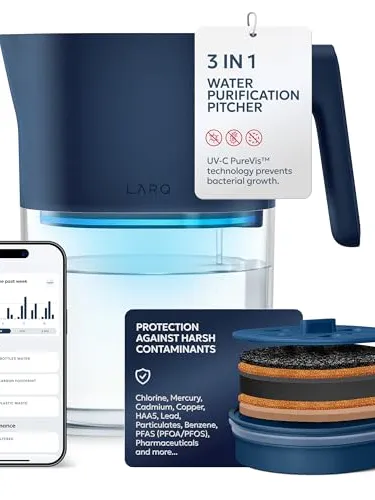
The Larq is probably the most tech-y water pitcher I tested, which will either excite you or frustrate you. Design-wise, it’s gorgeous and functional: lightweight, sleek, and compact enough to fit comfortably in a refrigerator. I especially love the hands-free fill lid, which lets you refill the pitcher without removing the top. A built-in indicator shows when it’s full, eliminating accidental overflows.